

Resin Anchor Bolt Anchorage Force Formation: Resin Annulus Thickness, Mixing Quality and Interfacial Bonding

Dayang Yang
AuthorWith over 15 years of experience in the production and sales of ground anchoring and mining support products, we operate our own rock bolt and accessory manufacturing facility with stable large-scale production capacity. We are specialists in rock bolts, resin cartridges, anchor cables, bearing plates, and customized ground anchoring products for mining support and geotechnical anchoring solutions.
A resin anchor bolt is often evaluated as though anchorage were a single number printed on a resin cartridge. In service, anchorage is a load path. The bolt must grip the resin, the resin must remain continuous and sound, the resin must grip the borehole wall, and the rock must accept the load. A weakness anywhere in that chain changes the result, even when every component meets its own specification.
That is why three common assumptions deserve scrutiny:
- If the bar has high tensile strength, the installed anchor has high capacity.
- If the cartridge fills the hole, the annulus is correct.
- If the bolt was spun during installation, the resin was mixed properly.
Each assumption contains part of the truth. None is sufficient on its own.
This article discusses two-component polyester resin cartridges used with pre-drilled rock bolts in mining and tunneling. It does not cover pumpable injection resins, cementitious grouts or general chemical anchors. The principles below apply across those boundaries only after the product and installation method have been checked.
Anchorage force is a system property
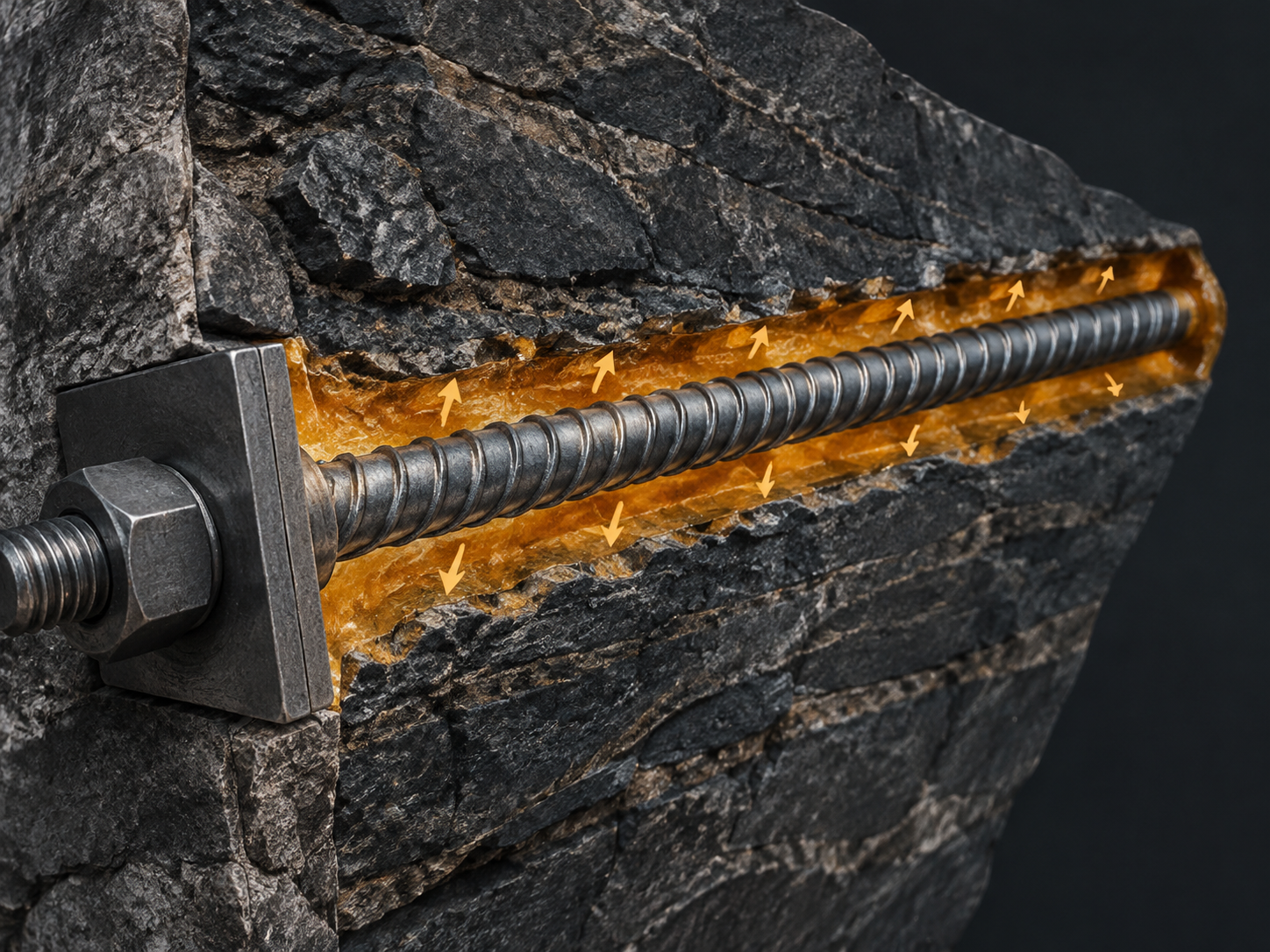
The first step is to separate four quantities that are often treated as interchangeable.
| Quantity | What it describes | What it does not establish |
|---|---|---|
| Bar tensile strength | The axial stress the steel bar can carry | Whether the installed anchor can transfer that load to the rock |
| Resin material strength | The behavior of a cured resin specimen under a defined test | Whether the resin filled, mixed and bonded in the borehole |
| Bond strength | Shear transfer per unit of bonded length for a particular test arrangement | The capacity of every bolt, hole and rock combination |
| Anchorage capacity | The load a specific installed system can carry before a limiting component or interface fails | A universal product rating |
Anchorage force is generated through a chain: bar, bar-resin interface, resin annulus, resin-rock interface and surrounding rock. Load is transferred by shear along the bonded length. The shear stress is not uniform from the collar to the toe. The loaded end carries a disproportionate share, and as debonding progresses, the transfer zone moves. This is one reason a longer bonded length does not automatically produce a proportional increase in capacity.
The practical consequence is simple: the installed anchor is limited by its weakest link, not by the strongest component in the catalog. A high-strength bar cannot compensate for incomplete encapsulation. A high bond strength cannot compensate for a rock mass that cannot accept the load. A resin with excellent laboratory strength cannot compensate for a mixing process that leaves part of the cartridge unmixed.
Resin annulus thickness is geometry before it is volume
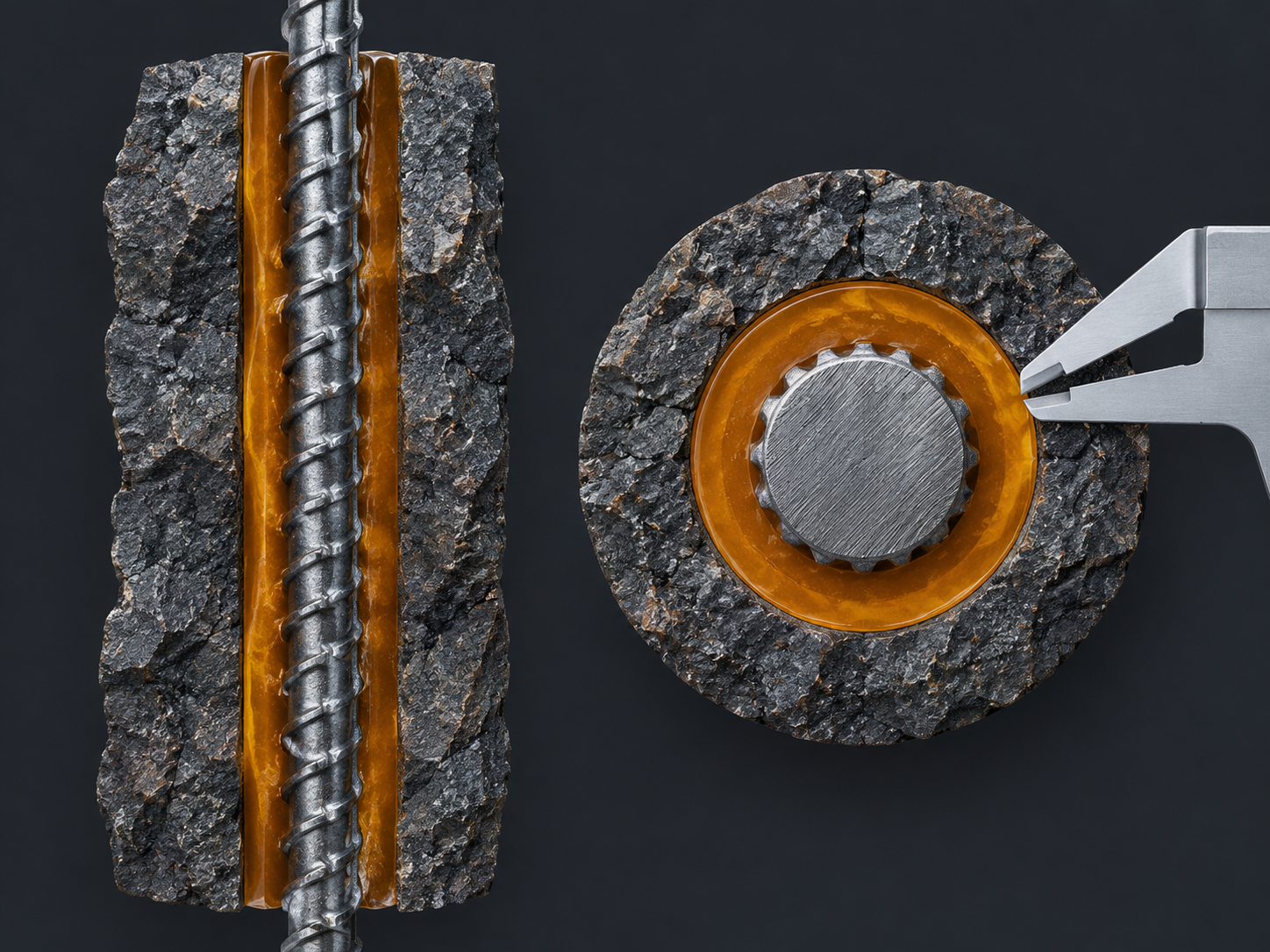
The resin annulus is the space between the bolt and the borehole wall that the mixed resin must fill. Its radial thickness is:
t = (D_hole - D_bar) / 2
where D_hole is the actual borehole diameter and D_bar is the actual bar diameter at the bonded section.
The distinction between radial thickness and diametral clearance matters. A 32 mm hole with a 25 mm bar has a 7 mm difference in diameter, but a nominal radial annulus of 3.5 mm. If one document quotes a 7 mm annulus and another quotes 3.5 mm for the same pair, they may be describing different dimensions. Ask which definition is being used before comparing numbers.
The cartridge is not the annulus
A resin cartridge has its own diameter, length and film construction. It must fit into the borehole, be punctured and shredded by the bolt, and release resin and catalyst into the annular space. The cartridge diameter therefore affects insertion, mixing and fill, but it is not the same thing as the final resin annulus.
The annular volume can be approximated as:
V = (pi / 4) x (D_hole^2 - D_bar^2) x L_b
where L_b is the bonded length. In practice, the required resin volume also has to allow for borehole irregularities, voids, fractures and resin loss. One manufacturer's fill chart includes a 15% allowance for borehole irregularities, but that allowance is specific to its chart and product range. It is not a universal factor.
This is why a cartridge should be selected from a documented bar-hole-cartridge combination, not from cartridge diameter alone. A long cartridge does not necessarily create a long bonded length, and a large cartridge does not automatically produce a better annulus.
Nominal hole size is not actual hole size
Drill-bit size is a starting point, not a measurement of the finished hole. Bit wear, overbreak, reaming, soft or fractured rock, hole closure and drilling technique can all change the actual diameter. A concentric calculation based on a nominal bit size can therefore overstate or understate the real annulus.
The same issue applies to the bar. Nominal diameter may not describe the profile at the bonded section, especially where ribs, threads or surface treatment are present. The annulus is a local condition along the bolt, not a single perfect cylinder.
Eccentricity adds another variable. If the bar lies against one side of the hole, the local annulus is smaller on that side and larger on the other. The average radial thickness may look acceptable while the resin distribution is not uniform. In a fractured hole, resin can also escape into voids, leaving parts of the intended bonded length without continuous encapsulation.
Why published optimum ranges differ
There is no single annulus thickness that can be applied to every resin, bar, rock and drilling system.
A South African roof-bolting guideline reports that, in one series of tests, the highest bond strengths were obtained with an annulus between about 2.5 mm and 3.8 mm, while an annulus below 2 mm appeared to reduce bond strength. The same document notes that those annuli were calculated from measured hole and bolt diameters, not from bit size. Other test programs and practical guidance have reported different preferred ranges, including a broader practical range around 4 to 6 mm in some work associated with Hagan's research.
Those numbers are not competing universal specifications. They reflect different test methods, bar profiles, resin systems and rock conditions. The useful conclusion is not "choose 3 mm" or "choose 5 mm". It is:
- The annulus must be designed together with the bar and cartridge.
- The actual hole diameter should be measured or controlled, not assumed from the bit.
- The selected combination should be supported by product data and, where conditions are unusual, site-specific verification.
An annulus that is too small can increase insertion resistance, prevent complete mixing or make complete encapsulation difficult to achieve. An annulus that is too large increases the volume that must be filled and the opportunity for voids, eccentricity or incomplete encapsulation. Both directions deserve attention. A larger annulus is not automatically a safer annulus.
Mixing quality is a process window, not a longer spin
A two-component resin cartridge keeps the resin mastic and catalyst separate until installation. The bolt must rupture the cartridge, shred the film and mix the two components while moving through the resin column. The chemical reaction then transforms the mixed material into a load-transferring solid.
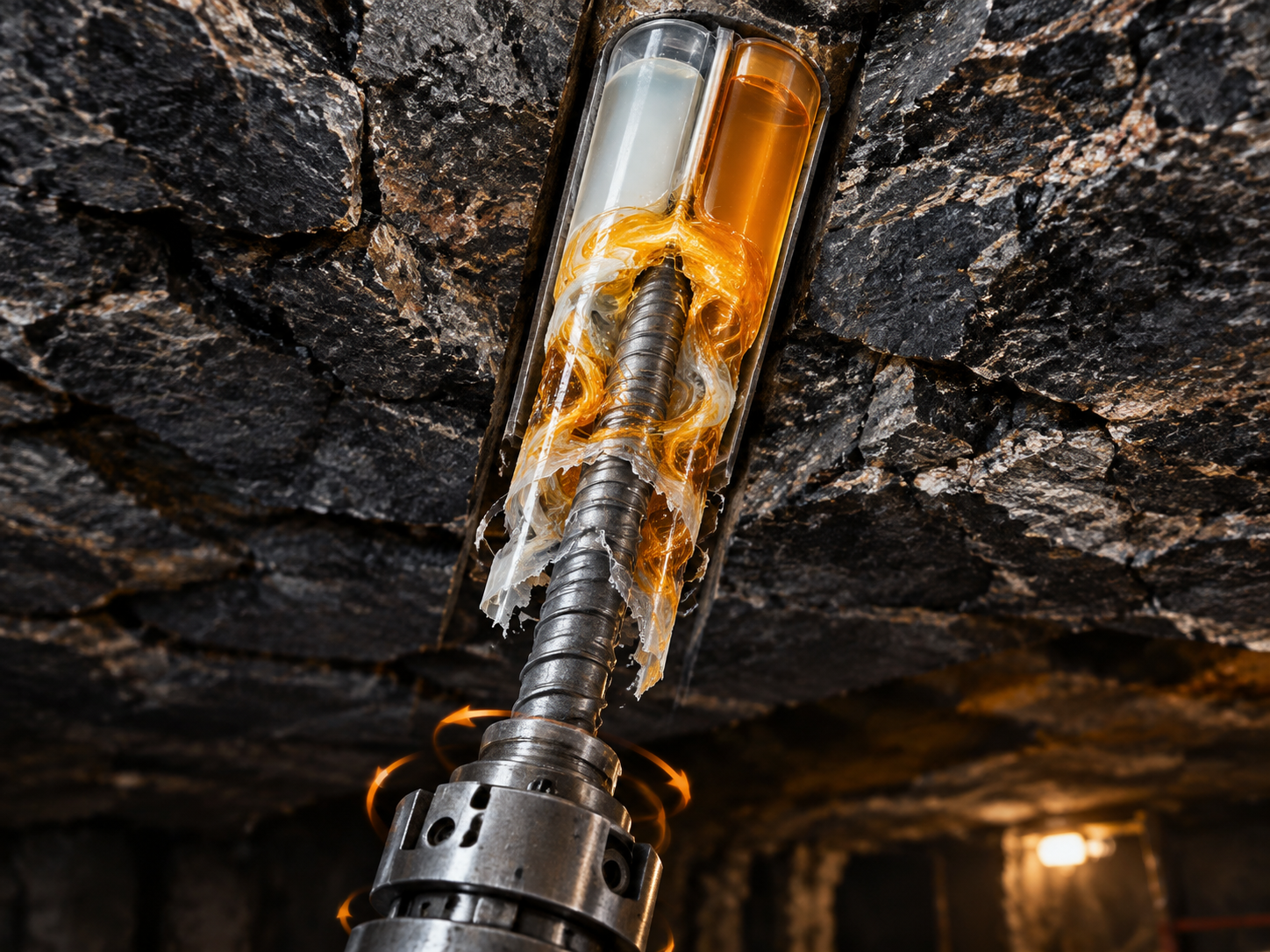
That sequence contains several distinct stages, and the industry does not always use the labels consistently.
| Term | What it refers to | What it does not mean |
|---|---|---|
| Spin time | The rotation period used to mix the resin and catalyst | Full cure or permission to load the bolt |
| Hold time | The minimum undisturbed period after mixing before tensioning or loading | The time required to develop all long-term strength |
| Gel time | The time from mixing to the onset of hardening | A universal installation time that applies to every product and temperature |
Manufacturers define and report these values differently. One J-LOK technical document states that, generally, spin time plus hold time is close to gel time. It describes spin time as the time needed to achieve complete mixing at a typical bolter rotation of 400 to 600 rpm.
A Minova Lokset data sheet gives product-specific spin and hold values. It also warns that the times vary with temperature, mining conditions, equipment, hole-to-bolt annulus, capsule age and storage conditions. Another Minova data sheet specifies a minimum number of revolutions for its particular capsule, rather than treating a fixed number of seconds as universal.
Those differences are not a contradiction. They show why a time copied from one product sheet cannot be transferred to another system.
Time is not the same as mixing energy
The number of revolutions matters as much as the clock. A bolt turned for 15 seconds at 300 rpm makes about 75 revolutions. The same 15 seconds at 600 rpm makes about 150 revolutions. If the mixer is slower, or the bolt is not advancing through the cartridge as expected, a time-only instruction may not produce the same mixing.
This is why a useful installation specification includes the equipment, rotation speed, thrust, insertion method and the point at which the spin period starts. It should also state what the operator is expected to observe, such as the bolt reaching the back of the hole and the cartridge being fully punctured.
Under-spinning and over-spinning fail in different ways
Under-spinning leaves resin and catalyst incompletely mixed. The result can be soft or unmixed pockets, poor strength development and incomplete bonding. In a hard-rock mine study, 37.5% of the recorded installations were under-spun and 62.5% were over-spun, while the recorded hold times were shorter than the recommended value. The study attributed these deviations to installation practice and noted that both early mixing and excessive mixing can affect the result.The percentages are specific to that mine and sample, but the mechanism is not.
Over-spinning can continue into the gel phase. Instead of improving mixing, rotation can disturb the developing gel structure or physically break up partially set resin. A Minova data sheet warns that mixing beyond the recommended spin time and into the gel time can damage the solidifying chemical.The exact consequence depends on the product, temperature and timing, but "more spin is safer" is not a valid rule.
The hold period is also part of the process. Tensioning or loading the bolt before the resin has developed enough strength can disrupt the bond that has just begun to form. Hold time is a minimum, not a target for full cure.
Gloving can hide in a normal-looking installation
Gloving is the incomplete destruction of the cartridge film. Instead of being fully shredded and dispersed, part of the film can wrap around the bolt or be pressed against the borehole wall. The film can create a low-friction layer at the resin-rock interface and reduce contact between resin and rock.
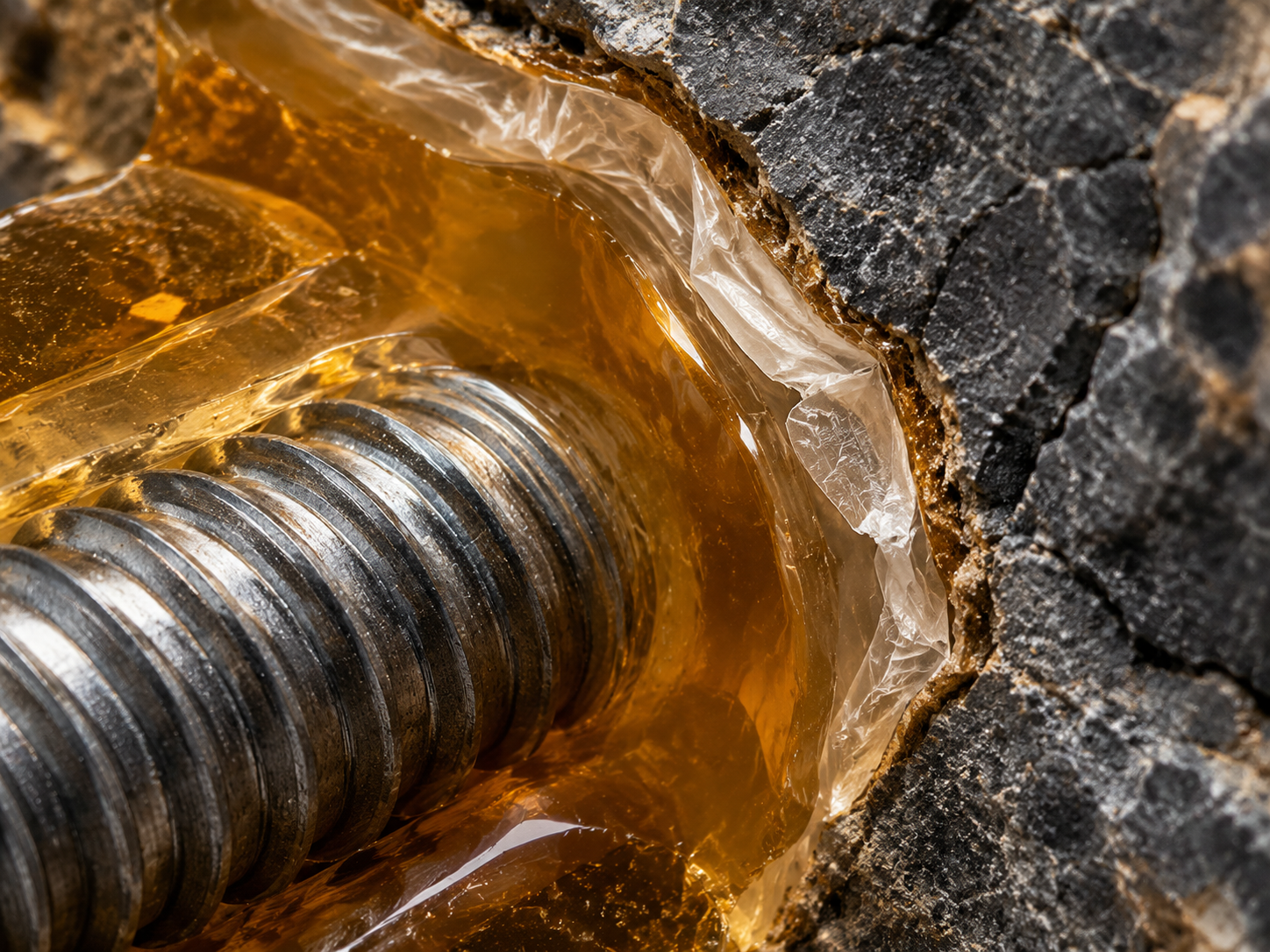
A field study of resin-anchored roof bolts recovered by over-coring found some degree of gloving in almost all of the recovered bolts within the top 300 mm. The study also found that greater gloving was associated with lower load transfer, although the relationship varied and the sample was limited to specific site conditions.Simulated gloving tests have reported much larger reductions than some field observations, which is a reminder that test method and geometry matter.
The practical lesson is not that every bolt with gloving will fail. It is that a visual check of the bolt head, or a successful pull test on one bolt, cannot prove that the full bonded length was mixed and encapsulated correctly. Mixing quality has to be controlled through the installation process and verified through an appropriate sampling and testing plan.
Interfacial bonding decides where the load path ends
Once the resin has filled the annulus and cured, load crosses two principal interfaces:
- Bar-resin interface: adhesion and mechanical interlock between the bar surface and the cured resin.
- Resin-rock interface: adhesion and mechanical interlock between the resin and the borehole wall.
The bar profile is part of the first interface. Rib height, rib spacing, rib angle and surface condition influence how the resin grips the bar. A South African study measured differences in rib geometry between roof bolts from different suppliers and concluded that the bolt profile should be treated as part of the support system, not as an interchangeable detail.
The borehole wall is part of the second interface. Roughness can improve mechanical interlock, but cuttings, mud, water, smeared rock or a weak surface layer can reduce contact. Drilling method and hole cleaning therefore matter. One study found differences in bond strength between wet and dry drilling, probably related to fine particles left after dry drilling; that result was specific to the studied rock and drilling conditions, not a universal instruction to change every drilling method.
In fractured or porous ground, resin can also escape into voids or fractures. The result is not necessarily a weaker resin mix. It may be a shorter effective bonded length, an incomplete annulus or a resin-rock interface that never formed over the intended area. This is why the same cartridge can perform differently in competent rock and fractured rock even when the bar and hole diameter are nominally the same.
A failure locus is evidence, not a verdict
The failure mode tells you which part of the load path reached its limit first. It does not, by itself, tell you which product was defective.
| Failure locus | What it can indicate | What it does not prove on its own |
|---|---|---|
| Bar-resin interface | The bar surface, profile, resin adhesion or local mixing may be limiting | That the resin material is weak |
| Resin-rock interface | Hole-wall condition, rock strength, resin loss or incomplete contact may be limiting | That the cartridge is the wrong size |
| Cohesive shear through the resin | The resin body or annulus geometry may be limiting | That mixing is the only cause |
| Rock mass | The bond is transferring enough load to fail the surrounding rock | That a stronger bolt would improve the system |
| Bar tensile rupture | The anchorage is strong enough to load the bar to its limit | That the installed system is optimal for the ground |
In one field study, almost all push tests failed at the resin-rock interface.Other test arrangements and rock conditions can shift the governing locus to the bar-resin interface or make the rock itself the limiting material.The contrast is important: the same resin technology can have a different governing interface when the bar profile, hole wall or rock changes. A single failure mode should not be marketed as the universal behavior of a product family.
What a pull test can and cannot prove
A rock bolt pull-out test is often presented as the final answer on anchorage. It is more accurate to call it a measurement of a specific assembly under specific conditions.
Short encapsulation pull testing deliberately uses a short bonded length to force the bond to fail within the test section. This allows the test to characterize bond strength and system stiffness instead of simply breaking the bar or loading a large volume of rock.[4] A full-scale pull test with a longer bonded length involves a different load distribution, a larger rock volume and a greater chance that the bar, rock or installation details will govern before the bond does.
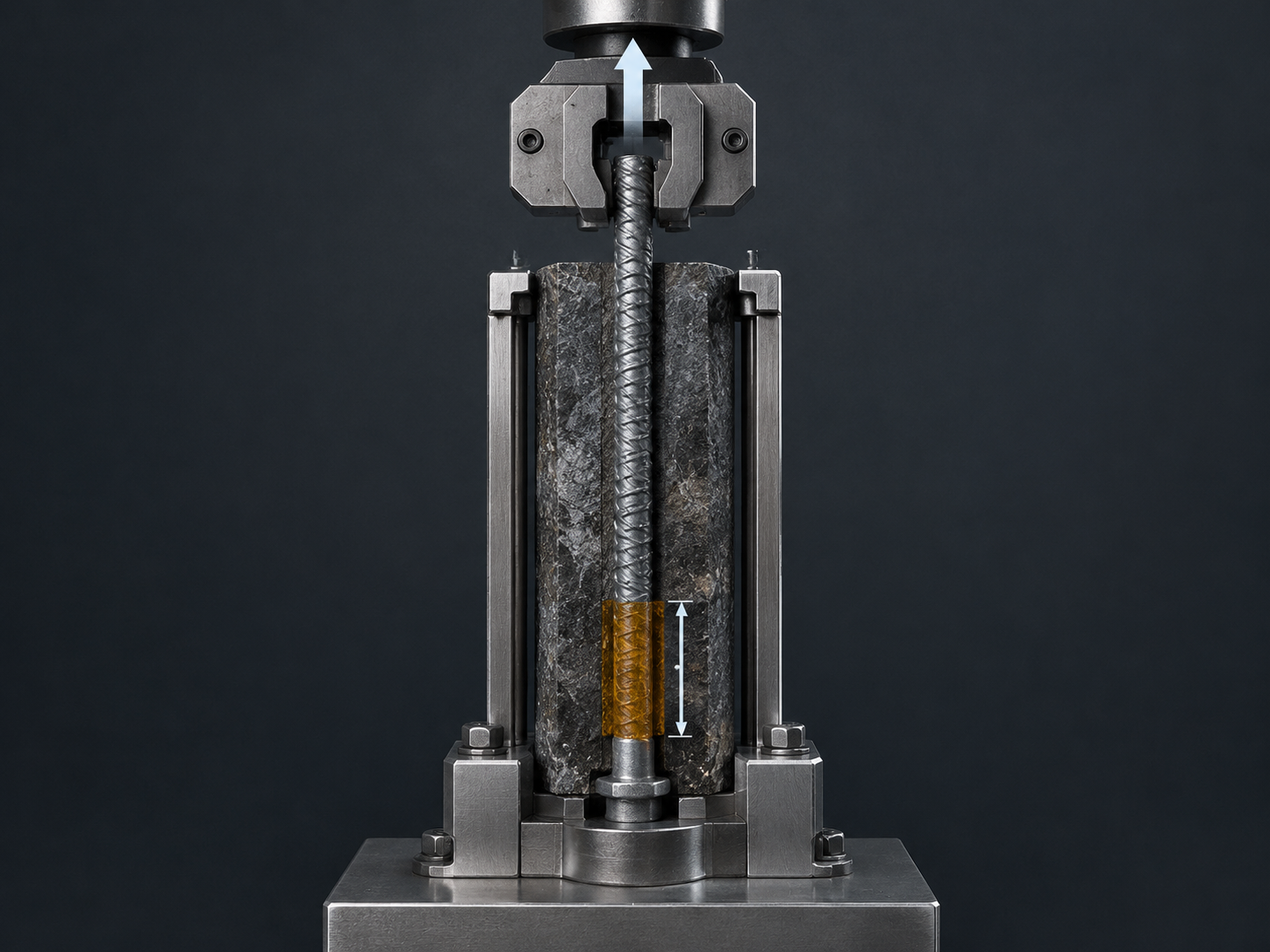
Both types of test are useful, but they answer different questions. A short encapsulation result is not automatically a full-length design capacity. A full-scale test that stops at a high load without reaching bond failure does not prove that the bond is adequate everywhere. The report needs to state what was tested, how it was supported, and what failed.
At minimum, a useful test record should identify:
- Bar type, diameter and surface profile.
- Actual hole diameter and drilling method.
- Resin product, cartridge size, quantity and batch or age information where relevant.
- Bonded length and test arrangement.
- Rock type, condition and confinement, or whether the test was performed in a substitute material.
- Temperature, curing time and loading procedure.
- Peak load, displacement, stiffness, residual behavior and failure locus.
Without those details, two peak-load numbers are not comparable. A test in a steel tube, a test in a concrete block and a test in a fractured rock mass are three different experiments. A result from one can inform the others, but it cannot be substituted for them without justification.
Buyer questions that reveal system thinking
The following questions are not a procurement form. They are a way to find out whether a supplier is treating resin anchorage as a system or repeating a catalog claim.
| Question | Why it matters | What a weak answer sounds like |
|---|---|---|
| What is the exact bar-hole-cartridge combination being proposed? | The annulus and fill volume depend on all three dimensions, not just the resin grade. | "Our resin works with all standard bolts." |
| Is the annulus quoted as radial thickness or diametral clearance, and is it based on nominal or measured hole diameter? | A nominal bit size can hide overbreak, wear, eccentricity or hole closure. | "The hole should be about 6 mm larger." |
| What spin, hold and gel values apply at our temperature, and at what RPM and thrust? | Time alone does not define mixing energy or the start of the mixing clock. | "Spin it for the usual time." |
| What failure mode did the test produce, at what bonded length, rock condition and curing time? | Peak load without failure locus and test geometry cannot be compared with another system. | "It passed a high pull test." |
| How is installation quality controlled across production bolts, not only the sampled bolts? | A test on one bolt does not prove that every bolt was mixed and encapsulated correctly. | "We test one bolt per batch." |
| What changes when the ground is wet, fractured or variable in diameter? | Resin loss, hole condition and annulus variation can change the effective bond. | "The same cartridge is used everywhere." |
A strong answer does not need to promise a universal number. It should explain the proposed combination, the conditions under which the data were obtained, the failure mode, and what still needs site verification. That is more useful than a single "high strength" claim.
Conclusion: the three variables are linked
Resin annulus thickness, mixing quality and interfacial bonding are not separate topics that can be optimized in isolation.
- The annulus sets how much resin is needed and how uniformly it can occupy the space around the bar.
- Mixing determines whether the resin can develop its properties and make contact with both surfaces.
- The interfaces determine whether the load can cross from the bar into the rock.
When an installed resin anchor underperforms, the useful question is not simply "Is the resin strong enough?" It is "Which link in the load path was not controlled, and what evidence shows that it was controlled in this installation?"
That is the difference between a product specification and an engineered anchorage system. The first describes a component. The second describes what the component can do in a particular bar, hole, rock and installation process.
CQ Rockbolt supplies resin anchoring materials and rock bolts for underground mining and tunneling. If you are evaluating a resin-anchored bolt application, send the proposed bar, borehole, cartridge and installation conditions, together with the project's test requirements, to discuss available products and supporting documentation.
Related News
Other news you might be interested in

Deep Mining & Long-Service-Life Tunnel Support: Key Factors for Rock Bolt Corrosion Protection and Long-Term Durability
A buyer can receive two quotations for “corrosion-resistant rock bolts” and still be unable to compare them. One may refer to a galvanized bar. Another may include epoxy-coated bars, sealed couplers, protected anchor heads, and a specified grout cover. Both descriptions sound protective, but they do not cover the same parts of the support system or provide the same kind of evidence.

Threadbar Coupler Compatibility: Drawings, Threads and Test Evidence Before Ordering
A threadbar coupler can look like a straightforward steel sleeve with a thread at each end. In practice, compatibility depends on the bar system, the complete joint arrangement and the evidence supplied for the exact product.A matching nominal diameter is not enough. Similar-looking couplers may use different thread forms, tolerances, engagement lengths or material conditions. They may also serve different purposes in a prestressing anchor, a mechanical reinforcement splice or another load-carrying assembly.Before accepting a quotation, establish what the coupler connects, which drawings control the joint and what the test report actually proves. These checks help buyers compare offers on the same technical basis.
Want to know more?
Get in touch with us for more information about our services and products.