
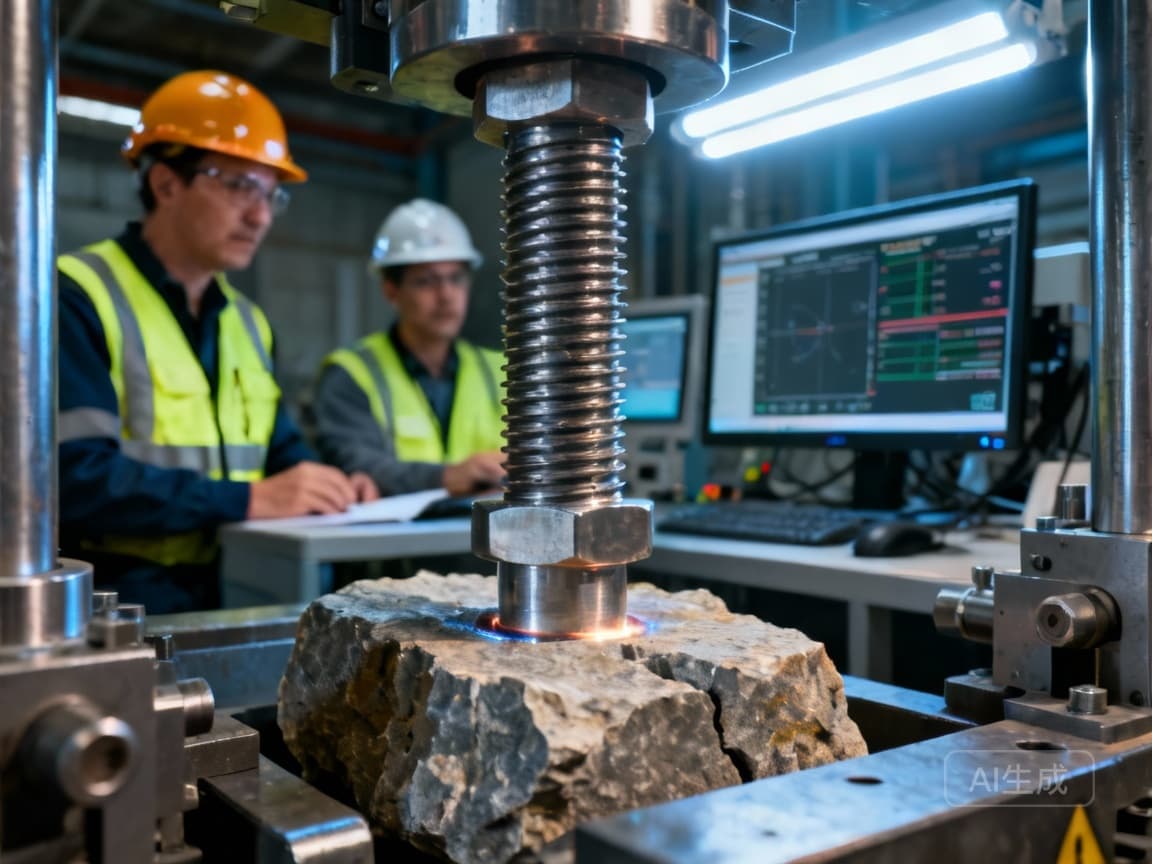
Beyond Guesswork: Optimize Mine Support Design with Full-Scale Shear Test Data

Dayang Yang
AuthorWith over 15 years of experience in the production and sales of ground anchoring and mining support products, we operate our own rock bolt and accessory manufacturing facility with stable large-scale production capacity. We are specialists in rock bolts, resin cartridges, anchor cables, bearing plates, and customized ground anchoring products for mining support and geotechnical anchoring solutions.
Beyond Guesswork: Optimize Mine Support Design with Full-Scale Shear Test Data
In deep mining and tunneling, the design of ground support is a critical balancing act. Underestimating ground stresses can lead to catastrophic failure, while over-designing leads to significant, unnecessary cost. For decades, engineers have relied on theoretical models and empirical rules for rock bolt selection. However, as projects delve deeper into complex geology, this traditional approach is increasingly inadequate. The industry is shifting from qualitative guesswork to quantitative, data-driven design. The key to this evolution lies in one critical activity: full-scale shear testing.
The Hidden Cost of Inadequate Design Models
Traditional rock bolt design often assumes a continuous, bonded connection along the bolt's length. This model works for standard grouted bolts but fails for modern, energy-absorbing bolts with discrete couplings. Using an incorrect model has two direct consequences:
- Over-Design: To compensate for uncertainty, engineers may specify excessive bolt density or length, inflating material and installation costs.
- Under-Design: More dangerously, the system may lack the specific capacity to handle shear movements across joints or faults, creating a latent safety risk.
This challenge is amplified by global trends. The global rock bolt market is projected to grow at a CAGR of 5.2%, driven by mining in emerging economies. Simultaneously, the rock bolt monitoring systems market is growing even faster at 8.1% CAGR, reflecting an industry-wide drive for greater safety and structural integrity through data.
Deconstructing Shear Behavior: The Power of Full-Scale Validation
To move beyond assumptions, leading organizations are investing in empirical validation. A seminal case study by SINTEF and Epiroc highlights this necessity. They conducted full-scale tests on energy-absorbing bolts using specialized rigs to apply combined shear and tensile loads—conditions replicating real-world fault movements.
The results were revealing. They identified three distinct shear responses, controlled not by a single factor, but by the interaction of:
- Presence (or absence) of grout column
- The bolt's internal reinforcement mechanism
- Whether the bolt is continuously or discretely coupled
For rock bolts with different design premises, such as discrete coupling, full-scale testing is mandatory to quantify their performance.
This data provides a performance fingerprint. Engineers can now compare the shear displacement-load curves of a traditional grouted bolt versus a modern energy-absorbing bolt, moving from a vague promise of "strength" to a precise understanding of how a specific product will behave under defined stress.
From Test Data to Design Input: A Practical Framework
Raw test data only creates value when integrated into the engineering workflow. Here is a practical, three-step framework to transform shear test results into optimized design.
Step 1: Geological Condition Mapping
Begin by critically assessing the geotechnical model. Identify zones where shear is likely to dominate: fault intersections, clay-filled joints, or regions of high differential stress. This prioritizes where advanced bolt data is most needed.
Step 2: Performance Data Matching
With risk zones identified, match the geological demand to product capability. For instance, in a zone with predicted 50mm of shear movement on a joint, select a bolt whose test data shows stable, high load-bearing capacity through that exact displacement range. This turns procurement from a generic specification to a performance-based selection.
Step 3: Integration into Numerical Models
The ultimate goal is to feed this precise performance data into numerical modeling software (e.g., FLAC3D, Plaxis). Instead of using a generic "bolt" element, engineers can calibrate models with the actual load-displacement curves from full-scale tests. This leads to more accurate simulations of ground-structure interaction, enabling optimization of bolt type, pattern, and spacing.
This framework is supported by other field insights. For example, analysis of high-stress tunnels shows that staggered bolt patterns can effectively capture and restrain spalling rock, and that timely installation after excavation is critical. These practical lessons, combined with quantitative data, form a robust design philosophy.
Quantifying the Value: Risk Mitigation as ROI
While specific ROI from testing is project-dependent, the value proposition is clear. Precise design can reduce over-conservatism, potentially cutting material usage. More importantly, it mitigates the profound costs of failure: project delays, remediation, and most critically, safety incidents. In an industry where safety is the paramount driver, investing in validated performance is investing in risk management. The growth of the monitoring market underscores this; it creates a feedback loop where design data is validated by real-world performance, continuously refining the process.
Your Action Plan for Data-Driven Design
To start eliminating guesswork from your support design, consider these steps:
- Audit Current Project Risks: Review upcoming projects in complex geology. Where is shear a credible failure mode?
- Demand Data from Suppliers: When evaluating rock bolts, request full-scale shear test reports for the specific products under consideration, especially for critical applications.
- Consider Collaborative Validation: For flagship projects with unique challenges, explore partnerships with manufacturers for project-specific testing. This tailors the solution directly to your geological context.
The future of ground support is not stronger materials, but smarter data. By leveraging full-scale shear testing, the industry can transform rock bolts from a commoditized component into a calibrated, performance-guaranteed element of intelligent engineering, ensuring both economic efficiency and paramount safety.
Related News
Other news you might be interested in

Resin Anchor Bolt Anchorage Force Formation: Resin Annulus Thickness, Mixing Quality and Interfacial Bonding
A resin anchor bolt is often evaluated as though anchorage were a single number printed on a resin cartridge. In service, anchorage is a load path. The bolt must grip the resin, the resin must remain continuous and sound, the resin must grip the borehole wall, and the rock must accept the load. A weakness anywhere in that chain changes the result, even when every component meets its own specification.

Deep Mining & Long-Service-Life Tunnel Support: Key Factors for Rock Bolt Corrosion Protection and Long-Term Durability
A buyer can receive two quotations for “corrosion-resistant rock bolts” and still be unable to compare them. One may refer to a galvanized bar. Another may include epoxy-coated bars, sealed couplers, protected anchor heads, and a specified grout cover. Both descriptions sound protective, but they do not cover the same parts of the support system or provide the same kind of evidence.
Want to know more?
Get in touch with us for more information about our services and products.